
How to Read an Ingredient Label—and Bring Your Food Closer to the Source
The Ingredient List Tells the Real Story
The front of a food package is marketing.
The back of the package is where the food begins to tell you what it actually is.
A product may advertise itself as:
Natural
Plant-based
High-protein
Heart-healthy
Made with whole grains
Gluten-free
Keto-friendly
No added sugar
Farm-grown
Multigrain
Ethically sourced
Made with real fruit
Those claims may provide some information, but none of them automatically make a product real food.
The most useful place to begin is usually the ingredient list.
Learning how to read an ingredient label allows you to look beyond attractive packaging and ask better questions:
What is this food actually made from?
Can I recognize the ingredients?
Which ingredients make up most of the product?
Were whole foods prepared—or was a product reconstructed?
Does this move my meal closer to its source or further away?
You do not need a chemistry degree, a food-tracking app or a perfect memory.
You need a simple framework.
How Do You Read an Ingredient Label?
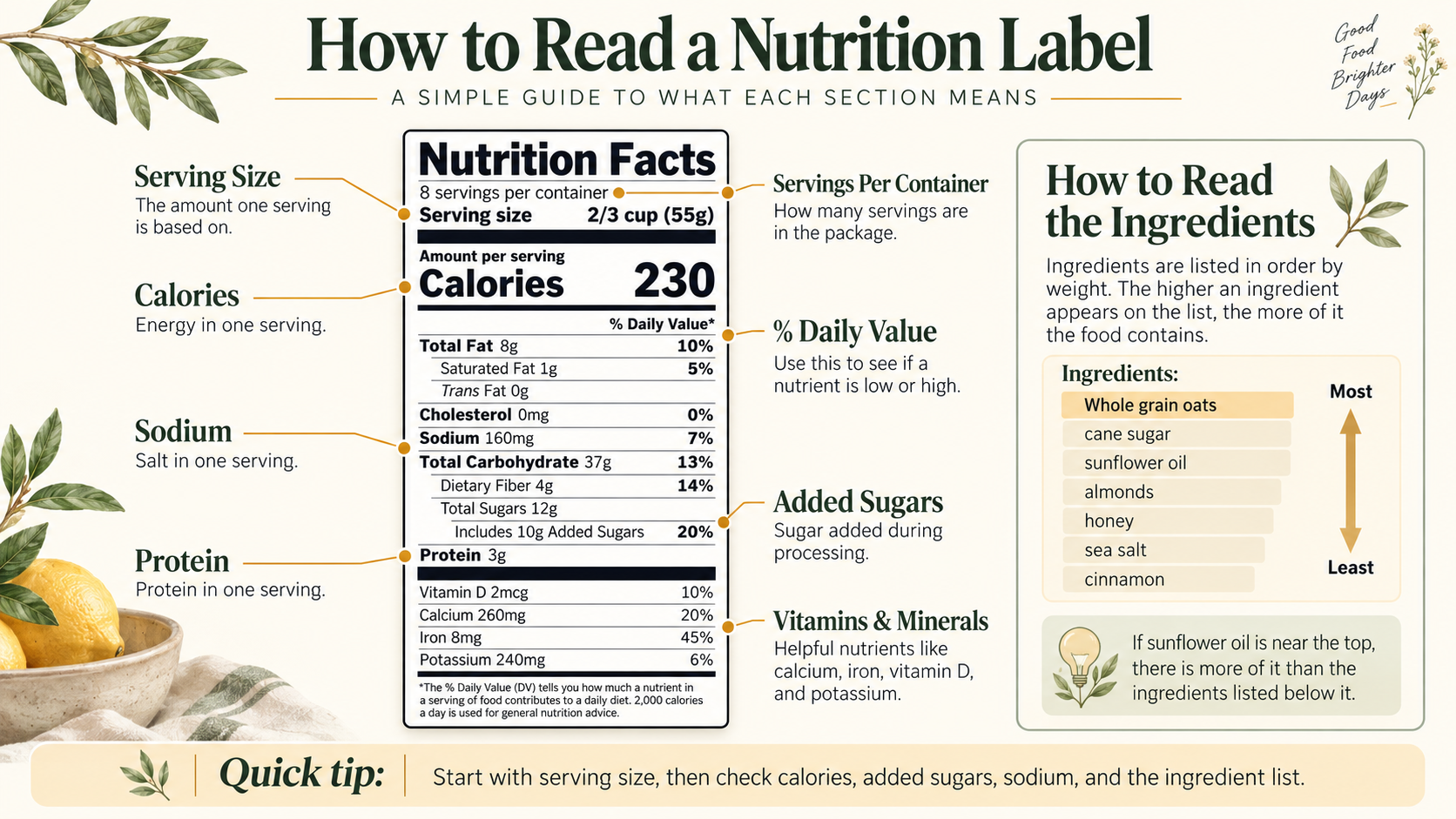
One of the simplest ways to make better food choices is learning how to read a label. I always read the ingredient list first, because what’s in the food matters most. I’m looking for seed oils, fake ingredients, and signs that a product is overly processed, while also looking for the cleanest option possible. After that, I check protein, carbs, serving size, package size, added sugars, and then calories. A package can say a lot on the front, but the ingredient list is what really tells the story.
To read an ingredient label, begin with the first three ingredients; identify the food that forms the product’s foundation. (The higher up on the list an ingredient is, the more of that ingredient it has in it.) look for added sweeteners and industrial oils, notice artificial colors, flavors and texture-altering additives, and determine whether you could reasonably recreate the food using recognizable ingredients.
Here is the short version:
Ignore the marketing on the front.
Find the complete ingredient list.
Read the ingredients.
What do you recognize, what do you not? (If you can't pronounce it or have never heard of it, that's not a good sign.)
Identify added fats and oils. (Seed oils BIG ⚠️ for me!)
Look for sweeteners.
Notice colors, flavors, gums and preservatives.
Examine any ingredients in parentheses.
Consider what has been added or removed.
Ask whether the food could be prepared in a home kitchen.
Look for an option closer to the source.
Let’s walk through each step.
Step 1: Turn the Package Around
The front of the package is designed to catch your attention and encourage you to buy.
Words such as natural, wholesome, fit, protein, grain-free and made with real ingredients can create a feeling without telling you much about the complete product.
Even the word natural is less definitive than many people assume. The FDA has a longstanding policy for its use, but it has not established a comprehensive formal definition addressing how a food was grown, raised or manufactured. FDA policy on “natural” labeling
Do not let the largest words on the package make the decision for you.
Turn it around and read the smallest ones.
Step 2: Find the Ingredient List
The ingredient list and Nutrition Facts panel serve different purposes.
The Nutrition Facts panel tells you about amounts of calories, protein, carbohydrates, fats, fiber, sugars, sodium and selected vitamins and minerals.
The ingredient list tells you what was used to make the food.
When I am evaluating whether something belongs in my real-food kitchen, I usually begin with the ingredients.
A product can have an impressive amount of protein or a carefully engineered calorie count while still containing refined oils, artificial colors, flavor systems, sweeteners and other ingredients I would not choose independently.
Nutrition numbers matter, but they do not tell the entire story.
Step 3: Read the First Three Ingredients
Ingredients are generally listed in descending order by weight. The ingredient present in the greatest amount appears first, followed by ingredients used in progressively smaller amounts. FDA explanation of ingredient lists
This means the first few ingredients reveal the product’s foundation.
If the first ingredients are:
Whole milk, cream, live cultures
You are looking at a very different food than one beginning with:
Water, corn syrup, modified food starch
Do not assume that an ingredient appearing near the bottom makes up a large part of the product. Likewise, do not overlook something simply because it appears later.
But always pay close attention to what comes first.
Ask:
What is this product mostly made from?
Step 4: Look Inside the Parentheses
One ingredient can contain its own long list of subingredients.
A label might say:
Chocolate chips (sugar, chocolate liquor, cocoa butter, soy lecithin, natural flavor)
Or:
Seasoning blend (maltodextrin, salt, sugar, natural flavor, yeast extract, spices)
The large ingredient named before the parentheses may sound simple, but the parentheses reveal what was used to make that ingredient.
Read all the way through.
A loaf of bread may appear to contain only a handful of main components until you examine the subingredients inside its flour blend, oil, dough conditioner or flavor mixture.
The complete list matters.
Step 5: Identify the Fats and Oils
Fat is not the enemy.
Traditional fats provide flavor, texture, satisfaction and important components used throughout the body.
The question is which fat was used and how it was produced.
Traditional culinary fats may include:
Butter
Ghee
Beef tallow
Lard
Duck fat
Extra-virgin olive oil
Coconut oil
Avocado oil
Industrial seed oils I avoid that are commonly found in packaged foods include:
Vegetable oil
Soybean oil
Corn oil
Canola oil
Cottonseed oil
Safflower oil
Sunflower oil
Grapeseed oil
Rapeseed oil
Rice bran oil
This is one of the clearest examples of moving away from traditional preparation.
People have fried, roasted and baked with animal fats, butter and other traditional oils for generations. Modern food manufacturing replaced many of those fats with inexpensive refined oils that could be used across an enormous range of packaged products.
You may find the same industrial oil in salad dressing, crackers, mayonnaise, frozen dinners, bread, chips, sauces and foods marketed as healthy.
When reading a label, ask:
What fat would I use if I made this at home?
If you would use butter, olive oil or tallow, but the packaged version uses a combination of refined seed oils, that tells you something about the distance between the product and its traditional form.
Step 6: Find the Added Sweeteners
Sugar can appear under many names.
Common added sweeteners include:
Corn syrup
High-fructose corn syrup
Dextrose
Glucose
Fructose
Maltose
Rice syrup
Brown rice syrup
Invert sugar
Malt syrup
Agave syrup
Fruit juice concentrate
Traditional sweeteners such as raw organic honey, maple syrup, molasses and date syrup are still sweeteners! Even traditionally processed cane sugar, coconut sugar, etc is real food! Their traditional origin does not mean quantity no longer matters.
The goal is not to panic whenever you see something sweet.
The goal is to know that it is there.
The Nutrition Facts panel now identifies Added Sugars separately from Total Sugars. Total Sugars can include naturally occurring sugars found in foods such as milk and fruit, while Added Sugars identifies sweeteners introduced during processing. FDA guide to added sugars
Check both the ingredient list and the Added Sugars line.
A product may contain several different sweeteners distributed throughout the ingredient list. Looking at the total added-sugar amount helps reveal their combined presence.
Step 7: Notice Artificial Colors
Artificial colors may appear as:
Red 40
Yellow 5
Yellow 6
Blue 1
Blue 2
Green 3
Other certified color additives
FDA-certified colors must be declared by name on the ingredient label. FDA color-additive labeling information
Within the Back to Source philosophy, I ask a simple question:
Why does this food need an artificial color?
A strawberry does not need red dye to look like a strawberry.
An orange does not need artificial orange coloring.
Butter does not need yellow dye to become butter.
Color may make an industrial product more attractive, consistent, or exciting, but it does not move that product closer to the original food.
This is something I used to overlook, but when you realize these dyes are the same ones you could use to dye your clothing, fabrics, etc., it resonates differently. What will all this dye do inside our bodies over the years?
Step 8: Pay Attention to Flavors
You may see terms such as:
Natural flavor
Natural flavors
Artificial flavor
Artificial flavors
Flavoring
Smoke flavor
A label may legally use collective terms such as “natural flavor,” “artificial flavor” or “spices” without naming every individual component involved. FDA ingredient-label guidance
That does not automatically mean every natural flavor is dangerous or that every unnamed spice is a problem.
It means the label is giving you less information than it would if it simply named the recognizable ingredient.
For example:
Strawberries
is more transparent than:
Natural strawberry flavor
And:
Garlic, onion, paprika and black pepper
tells you more than:
Flavoring
Back to Source favors ingredients that do not need to hide behind a manufactured flavor identity.
It's a topic for another time, but I will take you down the "natural flavoring" rabbit hole soon. You won't believe what that actually means... (Beware to those who are brave enough to search lol)
Step 9: Look for Ingredients That Rebuild Texture
Ultra-processed foods are often designed to maintain a specific texture through manufacturing, shipping, storage and reheating.
You may see:
Emulsifiers
Gums
Modified starches
Stabilizers
Thickeners
Anti-caking agents
Dough conditioners
Protein isolates
Hydrolyzed proteins
Textured proteins
Not every unfamiliar ingredient is automatically harmful.
For example, ascorbic acid is vitamin C. Lecithin also occurs naturally in foods such as egg yolks, although commercial lecithin can be used as an industrial emulsifier.
An unfamiliar name is a reason to investigate—not a reason to panic.
The broader pattern matters.
One thickener in an otherwise recognizable food is different from a product constructed almost entirely from refined starches, isolates, gums, oils, colors and flavor systems.
Ask:
Are these ingredients helping preserve a real food, or are they creating the experience of food from industrial components?
Step 10: Notice Preservatives—but Understand Their Purpose
Preservation is not inherently bad.
Salt, sugar, vinegar, fermentation, drying, smoking and cool storage have preserved food for generations.
Modern packaged products may use additional preservatives to prevent spoilage, inhibit microbial growth, protect color or extend shelf life.
The presence of a preservative tells you that the product was designed to remain stable for a particular period and distribution system.
That does not automatically tell you whether the complete food is appropriate for you.
Consider:
What is being preserved?
How long must it remain shelf-stable?
If I made it at home, how long would it stay good?
Could traditional preservation accomplish the same purpose?
Is the preservative supporting an otherwise recognizable food?
Or is it one part of a much larger ultra-processed formula?
Context matters.
What Does “Back to the Source” Mean? (or at least closer!)
Closer to the source means choosing food that remains nearer to its natural origin, traditional preparation, and recognizable ingredients.
It asks us to consider more than whether a food technically began as a plant or animal.
A cheese-flavored snack may have begun with corn.
A sweetened fruit drink may have begun with fruit.
A frozen chicken product may contain some chicken.
But the source alone does not tell us how much refinement, reconstruction and alteration occurred along the way.
Back to Source asks:
Can I identify the original food?
How many steps separate it from its natural form?
Was it prepared with traditional kitchen methods?
What was added?
What was removed?
How was it grown or raised?
Could I make something similar in my kitchen?
Is there a version with more recognizable ingredients?
The closer a food remains to its source, the easier it usually becomes to understand what you are eating.
The Back-to-Source Spectrum
Food does not always fit into a perfect binary of real or fake.
It can exist along a spectrum.
Closest to Source
A whole ingredient grown, raised or gathered with thoughtful practices:
A homegrown tomato
Eggs from pasture-raised happy, healthy hens
Grass-fed & Finished beef from a local rancher who loves his cows, lets the graise in the beautiful sun, and lets them live free
Wild-caught fish from their natural habitat or traditionally farmed
Fresh herbs from the garden
An organic potato
Raw milk from a trusted local farm where legally available
Traditionally Prepared
Recognizable foods transformed through familiar methods:
Butter made from cream
Yogurt made from milk and cultures
Sourdough made from flour, water, salt and starter
Broth made from bones, water, vegetables and herbs
Sauerkraut made from cabbage and salt
Cheese made from milk, cultures, enzymes and salt
Convenient but Recognizable
Packaged foods that still maintain a clear connection to their ingredients:
Plain frozen vegetables
Canned tomatoes with salt
Unsweetened applesauce
Plain yogurt
Canned beans with water and salt
Sardines packed in olive oil
Bread made from flour, water, starter and salt
Further From Source
Products containing recognizable foods alongside refined oils, sweeteners, flavors, colors or stabilizers:
Sweetened flavored yogurt
Crackers made with refined flour and seed oils
Bottled dressing containing soybean oil and flavoring
Breakfast cereal with added sugar and colors
Frozen meals containing modified starches and flavor systems
Industrially Ultra-Processed
Products reconstructed from refined substances and designed primarily through industrial formulation:
Artificially colored candy
Imitation cheese products
Packaged snack cakes
Flavor-coated chips
Products built primarily from isolates, refined oils, syrups, colors and flavoring agents
This spectrum is not meant to give every food a moral score.
It is a tool for seeing direction.
An Example: Reading a Yogurt Label
Imagine two strawberry yogurts.
Yogurt A
Ingredients: Whole milk, organic strawberries, honey, live cultures.
This product is easy to understand.
You can identify the dairy, fruit, sweetener and cultures. You could reasonably combine similar ingredients in your own kitchen.
Yogurt B
Ingredients: Cultured low-fat skim milk, corn syrup, sugar, modified corn starch, natural flavors, red color, gelatin, potassium sorbate, guar gum, and other natural flavors.
This product may still contain cultured milk, but additional ingredients were used to sweeten it, reconstruct its texture, intensify its flavor, adjust its appearance and extend its shelf life.
The question is not simply:
Does this contain yogurt?
The better question is:
Which one remains closer to yogurt as it was traditionally made and eaten?
Another Example: Reading a Potato Product
Option A
Organic potato roasted with tallow, salt, garlic and rosemary.
Option B
Frozen potato pieces containing potatoes, vegetable oil, modified starch, dextrose, artificial flavor, stabilizers and color.
Both began with a potato.
But they did not remain equally close to it.
The first option uses a whole ingredient and a traditional cooking fat.
The second requires additional ingredients to manufacture a consistent packaged product.
Reading the label helps you see the distance.
A Simple Ingredient-Label Formula
When you are standing in the grocery store, use this five-question check:
1. What is the first ingredient?
This reveals the product’s primary foundation.
2. Can I recognize most of the ingredients?
Look for foods, herbs, spices, salt and traditional culinary ingredients.
3. Which fat or oil was used?
Determine whether the product uses a traditional fat or an industrial seed oil.
4. What was added for sweetness, color, flavor, texture or shelf life?
Identify the job each additional ingredient performs.
5. Is there another option closer to the source?
Compare products—or consider whether the food could be prepared simply at home. The more you learn in the kitchen and grow as a cook over time, the more and more confident and adventurous you will feel! Soon enough you will feel like you can make anything better than the big brands, right from your own kitchen.
You do not need to analyze every molecule.
You are looking for the overall story.
Short Ingredient Lists Are Helpful—but Not a Perfect Rule
A shorter ingredient list often makes a food easier to understand, but length alone does not determine quality.
A soup may contain:
Beef
Broth
Potatoes
Carrots
Celery
Onion
Garlic
Butter
Parsley
Thyme
Salt
Pepper
That is a relatively long ingredient list, but every ingredient is recognizable.
Meanwhile, a product with only three ingredients could still contain:
Refined flour
High-fructose corn syrup
Vegetable oil
The goal is not always fewer ingredients.
The goal is better, recognizable ingredients.
Difficult Words Are Not Automatically Dangerous
Real food education should make you more capable—not more afraid.
Some ingredients have scientific or unfamiliar names but are still recognizable substances.
For example:
Ascorbic acid is vitamin C.
Sodium bicarbonate is baking soda.
Acetic acid is the primary acid in vinegar.
Tocopherols are forms of vitamin E.
Do not base your entire decision on whether you can pronounce a word.
Look it up. (ChatGPT will save you so much time!)
Learn why it is present.
Then decide whether it aligns with your standards and your movement toward the source.
Confidence comes from understanding, not fear.
Read the Serving Size Too
This one is tricky; the package size differs from the suggested serving size. Nutrition information is generally based on the serving size listed at the top of the Nutrition Facts panel. A package may contain more than one serving, so the amounts shown may not represent everything you actually consume. FDA serving-size guidance
Check:
The stated serving size
The number of servings in the package
Added sugars
Protein
Fiber
Sodium
The fats present in the ingredient list
Serving size does not define how much your individual body must eat. It tells you the quantity used to calculate the numbers on that label.
Check the Allergen Statement
If you have food allergies, label reading is not merely about food philosophy—it is a safety practice.
Major allergens must be identified on regulated food labels. These include milk, eggs, fish, crustacean shellfish, tree nuts, peanuts, wheat, soybeans and sesame. FDA allergen-labeling guidance
Look at both:
The full ingredient list
The separate “Contains” statement, when present
People with serious allergies may also need to consider cross-contact warnings and contact the manufacturer when information is unclear.
Do Labels Such as Organic and Non-GMO Matter?
These labels answer questions that the ingredient list cannot.
An ingredient list can tell you that a product contains corn, but it may not tell you how that corn was produced.
USDA Organic
A packaged product labeled organic and carrying the USDA Organic seal must contain at least 95% certified organic ingredients, excluding salt and water. The remaining ingredients must meet applicable organic requirements. USDA organic-labeling standards
Made With Organic Ingredients
A product labeled made with organic must contain at least 70% certified organic ingredients, excluding salt and water. It cannot use the USDA Organic seal. USDA “made with organic” requirements
Non-GMO
A non-GMO claim addresses genetic engineering. It does not necessarily mean the product is organic, pesticide-free, minimally processed or made without industrial seed oils.
A product can be non-GMO and still be highly processed.
Again, one claim does not tell the whole story.
Read the ingredients first, then use certifications and sourcing labels to learn more.
What If the Better Option Is Not Available?
Choose the best option reasonably available to you. You have to eat every day, so you can choose something better each time. :)
Back to Source is a direction—not a purity contest.
A plain grocery-store potato is still closer to source than artificially flavored chips.
Conventional eggs are still closer to source than a packaged breakfast bar.
Plain frozen vegetables may be more practical than fresh vegetables that will spoil before you use them.
A simple store-bought loaf may be the bridge that eventually leads you to bake sourdough.
Do not become so focused on perfection that you stop eating, cooking or progressing.
Ask:
What is one step closer from where I am now?
Then take that step.
Frequently Asked Questions About Ingredient Labels
Are ingredients listed in order?
Yes. Food ingredients are generally listed from greatest to least by weight. This makes the first few ingredients especially useful when identifying what primarily makes up a product.
Is a short ingredient list always healthier?
No. Ingredient quality matters more than length alone. A long list of recognizable soup ingredients may be closer to source than three heavily refined ingredients.
Does “natural” mean a food is minimally processed?
Not necessarily. The term does not comprehensively describe how a food was grown, raised or manufactured. Always read the complete ingredient list.
Are all preservatives bad?
No. Preservation includes traditional methods such as salting, fermenting, drying and pickling. Evaluate the particular preservative, its purpose and the complete food.
Are natural flavors the same as whole-food ingredients?
No. “Natural flavor” describes a flavoring category rather than clearly naming the source ingredient. It may be permitted on a label without disclosing every component. (Look this one up... it can be gross.)
Does organic mean there are no additives?
No. Organic packaged foods can still contain multiple ingredients. Certification addresses production standards, but you should still read the complete ingredient list.
Does non-GMO mean organic?
No. Non-GMO addresses genetic engineering. Organic certification includes broader production requirements.
Are frozen foods real food?
Plain frozen meat, fruit and vegetables can remain very close to source. Check for sauces, oils, sweeteners and other additions.
Are canned foods real food?
They can be. Look for recognizable ingredients and appropriate packaging. Tomatoes, beans, fish and fruit can all be canned without becoming ultra-processed.
What ingredients should I avoid?
Rather than memorizing one universal list, start by limiting artificial colors, artificial flavors, industrial seed oils, heavily refined sweeteners, and products made primarily from industrial additives. Individual needs may require additional considerations.
Or... make it even simpler! If you remember ANYTHING from my content, remember these two things:
Cook with real food
Bring it closer to source as much as you can
;)
Your food and life will be more vibrant and healthy!
How can I tell whether a food is ultra-processed?
Look for a product built from refined substances, isolates, industrial oils, flavor systems, colors, emulsifiers and other additives rather than recognizable whole-food ingredients.
Bring Your Food One Step Closer
Reading labels is not about becoming frightened of the grocery store.
It is about becoming harder to mislead.
Every label you understand gives you more power to decide what enters your kitchen, what nourishes your body and what you serve to the people you love.
You do not have to memorize every ingredient.
Remember these questions:
What is it?
What is it mostly made from?
Can I recognize the ingredients?
How was it prepared?
What was added?
Is there an option closer to the source?
That is Back to Source Cooking.
[EXPLORE THE COMPLETE FOOD FAMILIES GUIDE]
Still unsure about an ingredient?
Email your question to cookwithrealfood@protonmail.com.
Cook With Real Food
Part of the Back to Source Method
Read beyond the marketing. Understand the ingredients. Choose closer to source.